The FACTS about Tennessee’s Education Freedom Scholarships
Ready to find out more? Here are the facts.


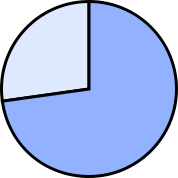
73% of K-12 parents in Tennessee SUPPORT
programs like the Education Freedom Scholarship (Source).
(Keep reading to find out why!)


Tennessee’s Education Freedom Scholarship
The freedom to choose what works best • Available to all • A place for every student • A smart investment for Tennessee’s future
What is an Education Freedom Scholarship?
The Education Freedom Scholarship is an ESA (Education Savings Account) that empowers Tennessee parents to choose the educational setting that works best for their child. The scholarship allows them to direct a portion of state funds ($7,295) toward their child’s education expenses, starting with fees at qualifying accredited Tennessee private schools. Curious if this might be right for your family? More details here. Education Freedom Scholarships fulfill the spirit of Tennessee’s Constitution Article XI, Section 12, which opens with these words: “The State of Tennessee recognizes the inherent value of education and encourages its support.”
Who is eligible for an Education Freedom Scholarship?
ALL K-12 students in Tennessee are eligible! Within six hours of applications opening for the program in its first year, over 30,000 had applied, demonstrating remarkable demand for options. Read the stories of why families want an Education Freedom Scholarship here.

Know the Facts
Let’s dive deep (together!)
How do Education Freedom Scholarships impact the state budget?
The program currently accounts for a mere 1.3% of K-12 spending in Tennessee and is a benefit for taxpayers. Here’s how.
Over $9.1 billion was spent on K-12 education in Tennessee in 2024-25, and that number has increased year over year, with an additional $1 billion in recurring funding that began in the 2023–24 school year. All told, Tennessee now spends more than $11 billion annually.
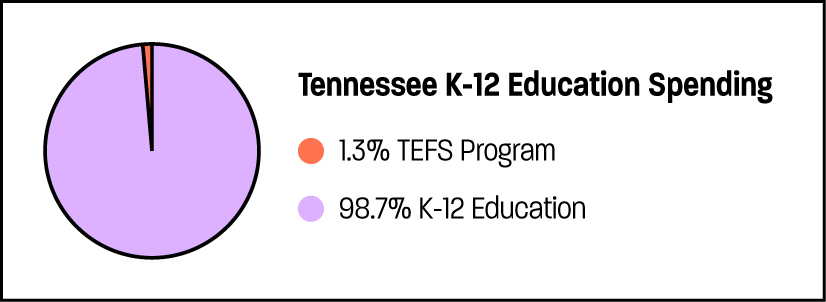
By comparison, the Tennessee Education Freedom Scholarship Program (TEFS) is investing $144 million in students this year – a fraction of the total budget (1.3% to be exact).
Each participating student receives a scholarship of about $7,300, roughly equal to the base per-student funding in the TISA formula. In total, public school students, meanwhile, are funded at about $10,000 per pupil from required state and local funds, not counting additional local funds or federal support. So students using an Education Freedom Scholarship are utilizing a smaller portion of taxpayer dollars for their education than students attending a public district school. This happens to be a win for taxpayers and students.
Can certain students be excluded from participating in the Education Freedom Scholarship program?
No! Education Freedom Scholarships allow every student to find the education setting that fits them uniquely – regardless of income, values, learning needs, or disability.
To serve every student’s unique needs means allowing a wide variety of schools to participate in the program and letting them do what they do best (all participating schools must be accredited). Making schools monolithic or requiring them all to serve students in the same way, hire the same type of staff, structure their classrooms the same way, accommodate all unique needs and disabilities regardless of class size, or adopt the same policies, practices, and values, would eliminate the uniqueness families are seeking and would lead to fewer excellent options – not more. Even articles that have complained about “discrimination” have invalidated their own point by telling the stories of families for whom one school wasn’t a fit while another participating school met their exact needs or celebrated their values in unique ways. Bottom line? There is a place for every K-12 student in Tennessee. The Education Freedom Scholarship makes it possible for more students to find that perfect fit.
What are the conditions and requirements for schools that are participants in the EFS program?
Every participating school in Tennessee’s Education Freedom Scholarship program must be accredited and comply with existing federal and state education laws.
The accreditation process imposes certain standards. The process to become a qualified private school includes:
- Becoming classified as a Category I, II, or III non-public school in accordance with State Board of Education Rule 0520-07-02.
- Having a physical location owned or leased in the state of Tennessee where students may receive educational services and testing.
- Registering with the Department to receive funds from the Program.
- Administering annual assessments (either a nationally norm-referenced test or TCAP) to scholarship recipients in grades 3–11.
- Reporting aggregated test data (by grade, income, race, sex) annually to the Office of Research and Education Accountability (OREA).
- Sharing test results directly with the parents of recipients.
Why do opponents call Education Freedom Scholarships a “voucher scam?”
Newsflash – Education Freedom Scholarships aren’t vouchers.
Rather, they are a form of Educational Savings Accounts, or ESAs. Unlike a traditional voucher program, ESAs are not directed to participating schools but instead towards parents and students. ESA students are able to use their scholarships on a multitude of approved education options beyond private school tuition, giving parents a true voice in their children’s education. ESAs do not direct any funding to specific schools, but they give families the ability to spend a portion of their education dollars on educational options that best fit the student.
Does the EFS program negatively impact public education in any way?
No, they actually just allow more students and families to find an education setting that works, which is consistent with the goal of educating Tennessee children.
Despite the dozens of school choice programs in existence, public schools still exist, with bigger budgets than ever before. Tennessee has made historic investments in public education in recent years, with many public schools still producing below-average results. In terms of funding, dollars for the EFS program are outside of the school funding formula and pale in comparison to the billions spent annually on the public education system. Currently, Tennessee’s Education Freedom Scholarship accounts for a mere 1.3% ($144 million) of Tennessee’s K-12 education spending ($11 Billion). The Education Freedom Scholarship program will spur innovation in education—both public and private—and provide more options to meet every student’s needs.
Does the program include academic accountability?
The program does not require any new testing, but scholarships are only available to category I, II, and III private schools, which are all accredited and already required to use high-quality nationally norm-referenced testing.
For students who stay in public school, research has shown the increased competition from school choice programs improves and brings more accountability to public schools. And in the most important and clear form of accountability, if a school or educational provider is not meeting a student’s needs, parents can take their child, and their education dollars, to another provider. In contrast, when a traditional public school fails students, they are often given more taxpayer dollars as a result, and parents may not have another choice.
Does school choice help improve educational outcomes?
There’s TONS of evidence that school choice improves outcomes across the board. Of nearly 190 empirical studies conducted on school choice programs, 84% have found positive effects.
These include positive effects on educational attainment, fiscal impact, parental satisfaction, racial integration, and even improvement in traditional public school performance due to competition. Arguably most insightful is that for Tennessee’s current geographically and income-limited school choice program, 99% of parents are satisfied with the program.
Some say school choice hurts rural communities and depletes their resources. Is that true?
On one hand, critics claim there are no private options for rural students, so the Education Freedom Scholarship won’t work in their communities. On the other hand, they claim it will bankrupt rural schools. Both can’t be true, and unsurprisingly, neither are.
Rather than harming rural communities, school choice often encourages new educational models, from microschools to hybrid programs, that bring more opportunity to smaller towns. This has played out in school choice strongholds like Florida, while data from every state shows that demand, parental satisfaction, and positive effects only grow over time. If there are no private options for rural students, then no scholarships will be used and the status quo remains the same. Some rural Tennessee families will utilize the new options available to them with the Education Freedom Scholarship, while others will remain content in their existing public school.
Are there income restrictions on Education Freedom Scholarships?
The Education Freedom Scholarship, like public district schools, is open to all students equally, regardless of income.
However, priority in awarding is given to those meeting income levels for the federal free or reduced-price lunch guidelines. The prioritization tiers for awarding scholarships for the 2026-27 school year and beyond are as follows:
- Students who received an EFS scholarship the previous year.
- Students from families who make less than 100% of income to qualify for free or reduced lunch.
- Students from families who make less than 300% of income to qualify for free or reduced lunch.
- Public school students and those entering kindergarten.
- All other applicants in the order the application is received by the Department of Education.